The audit is in 90 days. You need evidence and a control set the auditor can follow.
A focused engagement to scope the program, close the gaps, and stand up the evidence base built on known regulatory frameworks. Walk into SOC 2, HITRUST, HIPAA, PCI, or NYDFS knowing exactly what you'll be asked.
Why This Matters
Audit failures rarely come from missing controls. They come from controls you can't prove you ran and a program with no governance behind it.
Your auditor doesn't grade intent. They grade evidence. The gap between "we do that" and "here are six months of tickets, approvals, and logs that show we do that" is where findings come from. And where organizations burn through engineering quarters trying to reconstruct history.
We run audit readiness the way the audit will run: scoped against the framework, the auditor, and the customer obligation; tested against known regulatory framework tasks; remediated with policy, control, and evidence built to the standard your auditor uses, and stood up early enough that the period is real, not assembled the week before.
80%
of audit deficiencies are caused by a failure to gather sufficient evidence.
Journal of Accountancy / SEC Enforcement Data
By The Numbers
75%
reduction in time spent on manual evidence collection compared to client-run programs.
Forrester Research Study
60%
average reduction in high-risk audit findings within the first year of activation
Gartner industry benchmarks
Three situations where we start.
Who This Is For
Situation 1
First audit on the calendar
A customer, investor, or regulator just made a framework non-negotiable. You have a date, a scope, and no defensible path to ready.
Situation 2
Re-certification with new findings risk
You passed last year. New systems, new people, and a new auditor partner mean this year is not a copy-paste. Internal owners are already stretched.
Situation 3
Cross-framework consolidation
You're running SOC 2 for customers, HIPAA for operations, and a state rule on top. Three teams, three binders, three versions of the same answer.
Best Outcome
A scoped framework map, a remediation plan, and an evidence base your auditor will accept.
Best Outcome
Controls re-validated against the current environment and evidence rebuilt for the new period.
Best Outcome
Controls tested once, cited against every framework you report against.
Before the Engagement: Readiness Assessment
Not sure which situation is yours? Start with our assessment.
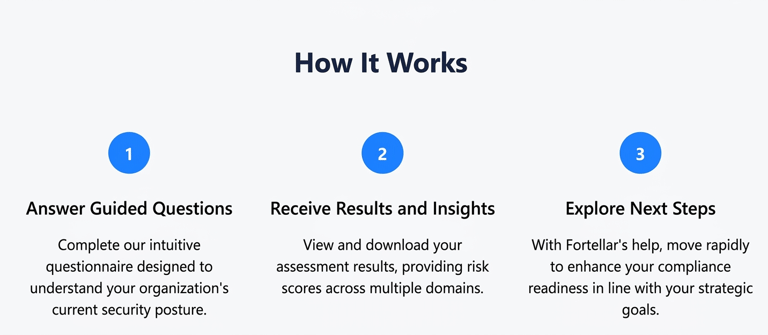
The Compliance Assessment Tool (CAT) is a self-serve diagnostic. Answer a focused set of questions about your environment, controls, and evidence. Walk away with a readiness score, a ranked gap list, and a one-page summary you can hand to your CFO or board. No call required.
Compliance Assessment Tool
NIST Risk Management Framework: Seven tasks, run in order.
Risk Management Foundation
RMF 1
Prepare
Organization-, mission-, and system-level activities to ready the program for risk decisions.
Working groups own indicators in their functional domain. Centralized reporting rolls them into a single board-ready view, so risk appetite and tolerance are set against real data. not anecdote.
RMF 2
Categorize
Determine adverse impact to operations and assets from loss of confidentiality, integrity, availability.
RMF 3
Select
Tailor and document the controls necessary to protect the system commensurate with risk.
RMF 4
Implement
Implement the controls and document the specific details in a baseline configuration.
RMF 5
Assess
Determine if controls are implemented correctly, operating as intended, and producing the desired outcome.
RMF 6
Authorize
A senior official accepts (or rejects) the security and privacy risk on the operation of the system.
RMF 7
Monitor
Maintain ongoing situational awareness of security and privacy posture in support of risk decisions.
Sustainable Governance.
Scalable Results.
What's Included
After this engagement, you will have:
A scoped framework map
Every control in your target framework mapped to the system, owner, and evidence type that satisfies it, all
cross-mapped across NIST RMF, HITRUST CSF, etc., so one map serves multiple audits.
After this engagement, you will have:
A remediation plan you can execute
Gaps ranked by auditor impact, effort, and dependency. Your engineering team can staff it without guessing priority.
After this engagement, you will have:
A live evidence base
Automated collection where systems support it, documented cadence where they don't. Evidence captured as it happens, not reconstructed before fieldwork.




After this engagement, you will have:
Tested control narratives
Written the way your auditor reads them. Reviewed in mock sessions before the real one, so the first time you hear the question isn't the real one.


After this engagement, you will have:
A trained program owner
Your internal lead knows the framework, the evidence, the auditor's logic, and how to chair the GRC forum after we hand off. We hand off a program, not a binder.


After this engagement, you will have:
A pass-path to continuous compliance
The control set, evidence base, and forum we stand up here become the foundation for running GRC as a program, not repeating this sprint next year.
How we actually get companies audit-ready, step-by-step.
How It Works
01
Start where the client is
We assess the real environment, not the aspirational one. Tools, processes, people, and the quality of evidence already on hand. Measured before anything is promised.
Tools: What's deployed, what's configured, what's actually used
Processes: What's documented vs. what happens on a Tuesday
People: Who owns what, where capacity is real, where it's stretched
Evidence quality: What would an auditor actually accept today
The same motion in five steps, written without framework jargon. The version we walk a CFO, a board, or a non-technical sponsor through when they want to know what we actually do between kickoff and the auditor's sign-off.
02
Map controls to reality
We align real operational behavior to framework requirements. Three questions per control, answered with evidence.
Does this control exist?
Is it operating?
Is it provable?
03
Build the missing pieces
We implement only what the gap requires. Documentation reflects reality, it doesn't manufacture it. Security, IT, and compliance are bridged explicitly, not run as silos.
Technology: Controls configured, integrations wired
Workflows: Handoffs that survive a real week
Governance: Owners named, cadences scheduled
Documentation: Only where it reflects what actually happens
04
Validate before audit
We pressure-test the program internally before the auditor does. No fieldwork surprises, no late-night staff burnout.
Mock evidence pulls against the real auditor's request list
Control walkthroughs run the way fieldwork runs
Risk scenarios stress-tested against the program
05
Maintain audit-readiness
We move clients off the annual scramble. The audit becomes a confirmation of a program that's already running, not a project that has to be rebuilt every year.
Continuous monitoring against the active control set
Ongoing evidence integrity, collected as it happens
Annual audits as confirmations, not events
Differentiator: XXXX
A readiness program run the way the audit runs, not the way a consulting slide deck runs.
Most readiness engagements end at a report. Ours end when your auditor signs. We test the way your auditor tests, write evidence the way your auditor reads, and stay in the room through fieldwork. The program we hand over is the one we just ran — built on NIST RMF, HITRUST CSF, and the OIG's Seven Elements, with a named program owner trained to run it after we step back.
Operating Posture
xx%
Engineer-led coverage
xx%
Engineer-led coverage
xx%
Engineer-led coverage
Expertise This Work Draws On
The components behind a running program.


Cybersecurity & Compliance
Compliance Framework Alignment
Control mapping across SOC 2, HITRUST CSF, HIPAA, PCI, NYDFS, ISO 27001, and NIST CSF. One environment, many frameworks, cross-mapped to NIST RMF tasks.


Cybersecurity & Compliance
Evidence Automation
Continuous collection of artifact, log, ticket, and approval data. The period is captured as it happens, not reconstructed later.


Cybersecurity & Compliance
Policy & Control Engineering
Policy written to the control environment you actually operate. Reviewed against auditor expectations before it goes into your program.


Technology & Security Operations
Logging & Audit Trails
Audit-grade logging across cloud, endpoint, and application estate; retained and searchable for the windows your framework requires.


Compliance Audit Readiness
Turn this sprint into a running program. One evidence base, every framework, every quarter
How this fits the rest of your program
Security Operations & Monitoring
Audit evidence and SOC telemetry from the same source. One pipeline, two outcomes.
Fractional CISO
When the program needs an executive owner across audits, customers, and regulators, not just one engagement.


Where To Next
The controls are probably real. The evidence is the problem.
Thirty minutes with a senior partner. Bring the framework, the auditor, and the date. We'll tell you what it takes to be ready.
Strategic technology partners
combining deep industry expertise with innovative solutions for regulated industries.

Services
Company
Expertise
© 2025 Fortellar. All rights reserved.